

Oschadbank v Russia: Anne-Sophie Tonin and Baptiste Rigaudeau comment on the Paris Court of Appeal ruling in Iurgium
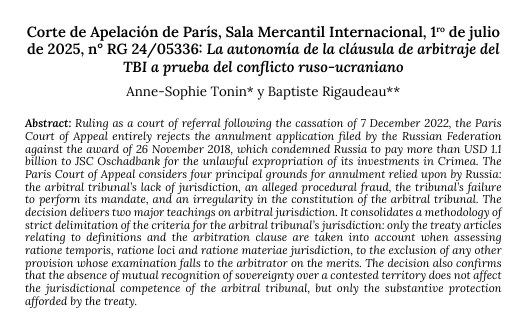
On 1 July 2025, the Paris Court of Appeal dismissed Russia’s application to set aside the Oschadbank award. The award orders Russia to pay more than USD 1.1 billion to the Ukrainian state-owned bank for the expropriation of its Crimean branch. In Issue 56/2026 of Iurgium, Lead up partners Anne-Sophie Tonin and Baptiste Rigaudeau analyse the ruling. They draw two lessons: only the treaty’s arbitration clause defines the arbitrators’ jurisdiction, and contested territory is still territory under the treaty.
A contribution to the 2025 review of French case law
Iurgium is the journal of the Club Español e Iberoamericano del Arbitraje (CEIA). Issue 56/2026 features a “Panorama of French case law 2025”. The CEIA French Chapter prepared the review, which was coordinated by Fannie Bruneau and Marcos Barradas. Anne-Sophie Tonin and Baptiste Rigaudeau wrote their commentary in Spanish.
The Oschadbank case at a glance
The award of 26 November 2018 orders Russia to compensate JSC Oschadbank, a Ukrainian state-owned bank. It concerns the expropriation of the bank’s branch in Crimea. Russia applied to the Paris Court of Appeal to set it aside, and the Court first annulled the award in 2021. However, the Cour de cassation quashed that decision on 7 December 2022 (No. 21-15.390).
The case then returned on remand to the International Commercial Chamber of the Paris Court of Appeal. On 1 July 2025, the Court dismissed Russia’s application in full (RG No. 24/05336).
Two lessons on arbitral jurisdiction
- A strict method for delimiting jurisdiction. Only the arbitration clause and the definitions article of the 1998 Russia-Ukraine bilateral investment treaty (BIT) govern jurisdiction ratione temporis, ratione loci and ratione materiae. Every other provision, including the temporal condition in Article 12, goes to the merits. It is therefore for the arbitrators to decide.
- Contested territory is still territory under the treaty. The lack of mutual recognition of sovereignty over Crimea does not affect the tribunal’s jurisdiction. It affects only the substantive protection afforded by the treaty.
Other grounds and the limits of the ruling
The commentary also reviews Russia’s other grounds for annulment: procedural fraud, the tribunal’s compliance with its mandate and the independence of a co-arbitrator. They were all rejected.
The authors note two limits, however. First, the line between jurisdiction and merits depends on how each treaty is drafted. Second, actual enforcement of the award remains uncertain.
Why the ruling matters for investors
In mining, energy and infrastructure, an investor may see control over a territory change during the life of a project. The Oschadbank ruling shows that such a change does not, on its own, close the door to arbitration. Treaty drafting remains decisive, however. It draws the line between what the annulment court reviews and what is left to the arbitrators.
Frequently asked questions
What did the Paris Court of Appeal decide in Oschadbank?
In a judgment of 1 July 2025 (RG No. 24/05336), the Court dismissed in full Russia’s application to set aside the award of 26 November 2018. The award grants more than USD 1.1 billion to Oschadbank.
Does an investment treaty cover territory whose sovereignty is contested?
According to the Court, the lack of mutual recognition of sovereignty over Crimea does not affect the tribunal’s jurisdiction. The issue bears only on the substantive protection afforded by the treaty.
Where can I read the commentary?
The commentary, written in Spanish, appears on pages 139 to 144 of Iurgium Issue 56/2026, published by the CEIA. The journal is also available on Kluwer Law Online.
Reference: A.-S. Tonin and B. Rigaudeau, “Corte de Apelación de París, Sala Mercantil Internacional, 1ro de julio de 2025, n° RG 24/05336: La autonomía de la cláusula de arbitraje del TBI a prueba del conflicto ruso-ucraniano”, Iurgium, Revista del Club Español e Iberoamericano del Arbitraje, No. 56/2026, pp. 139-144.
Facing an investment treaty dispute or a challenge to an award? Contact our team or visit our Investment arbitration page.